Enabling Creativity – bringing makers into the classroom
The Maker Movement as Time Magazine states “moving from passive users to active creators” (Bajarin, 2014). This SBS article introducing Leila who is one of three female bladesmiths in Australia (at 14) is a perfect demonstration of the movement and how “arts meets technology” (Costello, 2017).
The Maker movement is evolving in creative community maker space settings, but also into schools. This is an exciting area especially for music education. Primary schools with their integrated curriculum, appear to be taking advantage of this movement with the ability to integrate coding, robotics, building their own musical instruments. Here the Australian Government Department of Education & Training, Digital Technology Hubs demonstrates a few key examples we investigated today including the explanation of Maker Spaces and demonstrating how students can even build their own instruments.
This week we explored Little Bits which uses battery voltage and a series of electronic pieces to manipulate the current through various input and output options to make something happen, be it manipulate sound waves, make something move like a propeller, turn a light on, or even build up to a star wars drone!
Makey Makey & Bare Conductive were also other kits we explored looking at how using different circuit boards and alligator clips can turn inanimate objects into sound triggers.
Makey makey acts as a keyboard extension tool so you can connect anything conductive from a banana to playdough or water and trigger sounds of movements through your computer. The alligator clips specifically link to what would be normal keyboard commands such as space bar, arrow keys, keyboard letters to allow alternate objects. It pairs well with Scratch to activate games and you can program in your own animation or ideas.
Similarly Bare conductive, uses an Arduino circuit board instead of working as a specific keyboard trigger, it uses up to 13 connectors for you to program in your own sounds. The good thing about Bare conductive is that it comes with a speaker and without the need for holding an earth point as with Makey Makey.
Here are some of my experiments as I work more with this technology for my overall project.
Roli Light Pad Blocks is a “modular music system” that allows you to program in a range of sounds and perform them using the modular block system. What’s really cool is that these “blocks” are touch sensitive that you can add vibrato effect, sliding and articulation into how you want these sounds to be expressed. You can then pair this with a DAW such as Logic Pro and use the blocks as your performance tool.
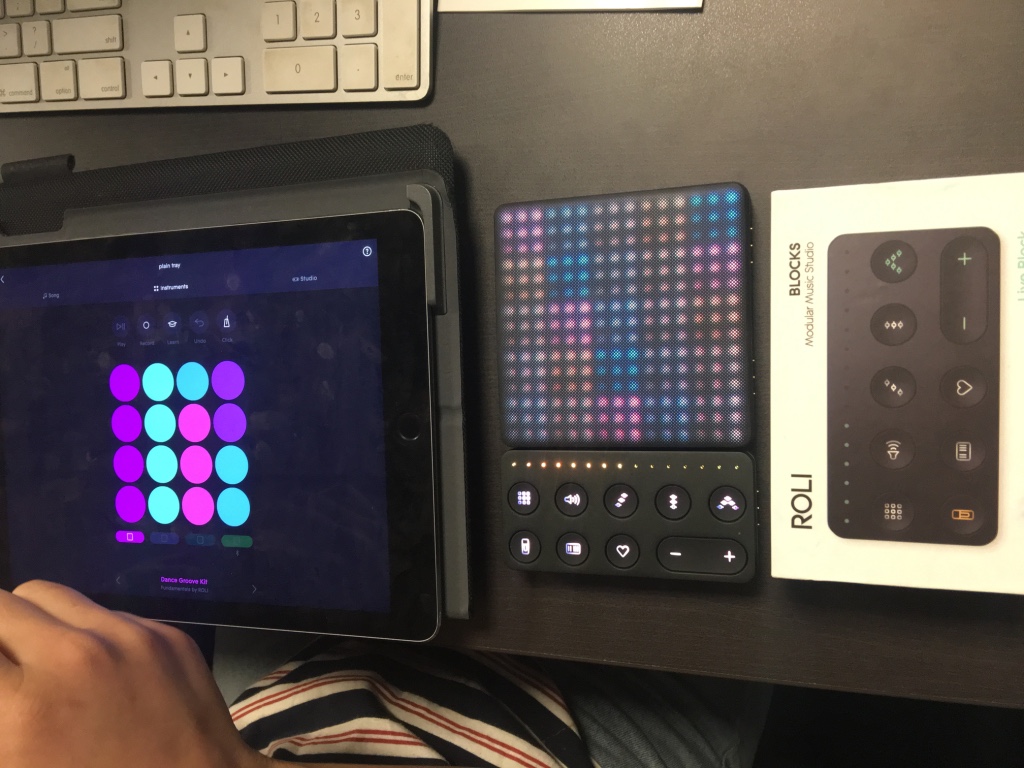
This also pairs with the Noise App to help program in the sounds. The modular system is magnetic which means you can add multiple blocks and also the Roli keyboard.
This is an amazing touch sensitive keyboard that I would love to get my hands on!
With all this amazing technology that is becoming more and more accessible, it’s important to keep coming back to understanding how these can be used in the music classroom. In particular I have been experimenting with Makey Makey and Bare Conductive to see how these applications can be incorporated. I’ve done some initial work with year 10 (Link to my previous blog and resource) and was able to incorporate the topic of 20th Century avant garde techniques by students recording their own compositions and having them played through Makey Makey. As a first go there was lots to learn, but have a few more ideas on how to improve this process and being able to integrate this technology.
 Previous Post
 Next Post