The Maker process that outweighed the project! (Almost!)
I have just completed my music technology project that I have been working on this last semester. All my content, process & unit outline and lesson resources are here. Please click and explore my video experiments and outcomes! But to really experience it as it is hands on come to the Sydney Conservatorium of Music, Technology Public Presentation of Learning on the 24th of November.
My main idea was explore various sound activation methods with Makey Makey and Bare Conductive while developing my recording skills and seeing how I can make these Maker Movement tools relevant for the music classroom.
So why the Maker Movement? Having seen the introduction of programs such as coding in my local primary schools and the greater emphasis on STEAM and project based learning with students “building relationship between objects and concepts” (Blikstein & Worsle, 2016, p. 90) to encourage abstract and practical thinking. I’ve been interested in how this sort of technology can be utilised and integrated in music education. I specifically like the idea of “enabling technology to bring real world experiences” (Burnard, 2007, p. 197), while ensuring that technology is an enabler not a detractor with integration to deliver “innovative infused curriculum, not an add on” (Wilkes & Wik, 2015).
During the exploration phase of this project, it dawned on me how much music composition and this maker project idea go so well together and brings great relevance to music education. It also turns out, I’m not alone in this thinking of how composition and technology seem to work well together (Otondo, 2016; Burnard, 2007).
My project then began focusing on music construction and reconstruction, linking that to the idea also of what the Maker Movement is about. My plan became to re-create Philip Glass Closing using Bare Conductive and re-create my own composition using Makey Makey.
The process of developing this project seems to have become more important than the project itself! I found myself:
- Composing and editing musical loops while making consideration to rhythmical outcomes, tempo adjustments, harmonic blending
- Organising musical ideas to be re-created in a performance process
- Exploring and investigating the use of technology to perform musical outcomes from Sibelius, Garage Band, Soundtrap, Scratch to 3D modelling in Tinkercad
- Engaging with maker community to develop 3D printing. Watching YouTube videos of how to use the technology and solve different problems I had
- Considering how texture, structure and instrumental layers can be displayed graphically in Scratch. This can be extended much much further
- What influence the recording quality of loops and dynamics can play in later performance activation
- Solving both musical and technological problems to get the outcome that I wanted
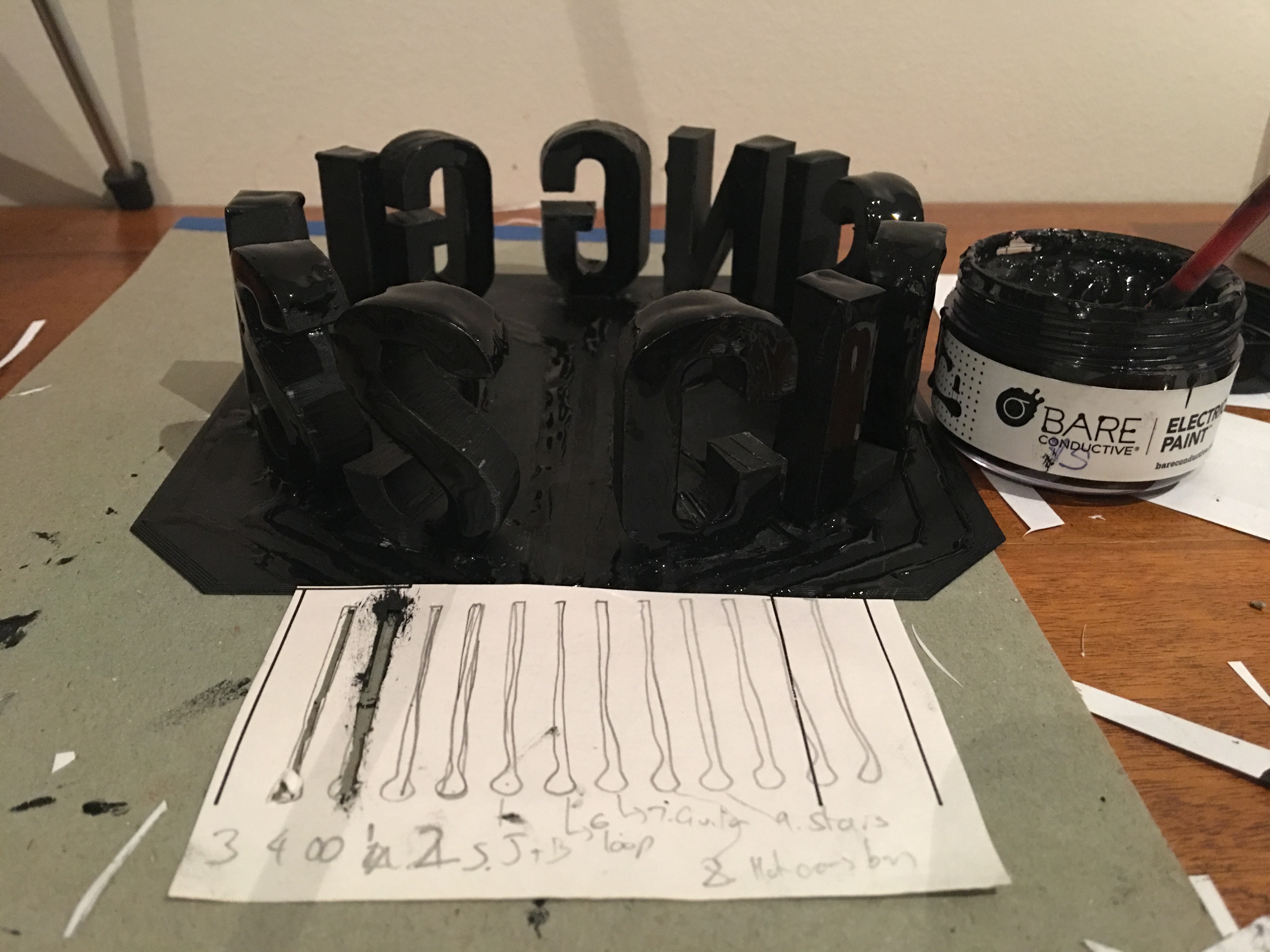
Reflecting the theory of how composition and technology can work so well together in delivering problem solving and musical skills (Blikstein & Worsle, 2016; Burnard, 2007; Otondo, 2016; Wise, 2011).
I’ve always wanted to have a music first approach with technology and incorporating my own composition work and other repertoire has really enabled me to do this. As another project outcome, I’ve developed a unit outline to recreate this project within the classroom, extending on the work I did previously with Year 10. This has a focus on composition and the utilisation of Maker Movement Technology. It is also flexible enough to apply the core ideas to a variety of topics pending musical learning requirements. With the integration of performance, composition, listening and technology integration, it is able to easily tick the syllabus outcomes while creating an engaging learning environment. To succeed students must use 21st Century skills such as collaboration, critical thinking, creativity, & communication, while incorporating time for both teacher and peer feedback. It even includes details as to how it can be assessed and a small provocation video to students during the unit.
My main idea behind this project was to see how I can incorporate Maker Movement technology in a meaningful musical way in the classroom. But above all, I have actually completed this project which I can now use as a model for students. I can anticipate problems and help students if they get stuck with their problems. I have an example they can use to hopefully extend even further in their own creativity. This benefit is perhaps the most valuable, all because I did the project first myself (James Humberstone, everyday!)
Just in case you missed it: it’s all here – https://sites.google.com/view/mergingmusictechandcomposition/home
If you want the video version it’s here too.
 Previous Post