The whole is greater than the sum of parts
Consideration to designing resources and online education.
In a previous blog I looked at various online/offline software resources for designing resources for students. Not only is it important to look at what method you choose to communicate your content, but also how you design it.
In design, there is a set of guiding principles based on Gestalt philosophy where the whole is perceived as a sum of all parts. These principles work together to guide the viewer/user through the image or communication and help create clarity as to what is really important (O’Connor, 2015).
The key design Gestalt principles are:
- Figure-Ground relationship: Consider the most important thing to be in focus or the “figure” with the “ground” being the background.
- Similarity: Grouping similar objects in the same shape, colour or proximity to help express the relationship between each other.
- Proximity: Grouped objects together provide stronger relationships and visual cues.
- Continuity: Providing a visual hierarchy of images/text.
- Common fate: How things are moving related towards each other, i.e. are they progressing in a line or down the page.
- Closure: Where our mind seeks to fill in gaps of patterns i.e. Missing letters of words.
Have a look at some graphic examples here.
These principles can also be translated to aural communication, particularly important when providing information to students. What we as teachers see or say that might be the most important message or task instruction i.e. the “figure” focus, students may be too distracted by the “ground” resulting in “mismatch” of communication (McInerney & McInerney, 2010, p. 79).
To promote the right level of retention and encoding (McInerney & McInerney, 2010) we also need to consider how we structure material to best enable this, for all learning types. We have to check:
- Does our verbal message support, repeat (resulting in redundancy) or confuse our visual message?
- Is our visual material laid out in a way that best supports the importance of the message, do the visual cues and groupings aid structure for understanding?
- Does the communication provide meaning that can be contextualised and seen as relevant to promote learning?
- Does the communication method promote encoding information in the way it is intended to?
These are questions I keep asking myself when I am designing resources, or even re-designing as I look at this blog.
When we consider how many distractions and information is presented to students (and adults) everyday, it is particularly important to make any information contextually relevant and in a format that will aid cognitive processing.
According to the Australian Interactive Advertising Bureau (IAB) that measure online audience activity with Nielsen, 20 million Australians are online each month. In a population of 24million (ABS), this is significant, even if there is some room for error on the measurement side. Google, Facebook followed closely by YouTube are the three largest unique audience views (that is the aim to only count a person once as a visitor even if they have visited multiple times).
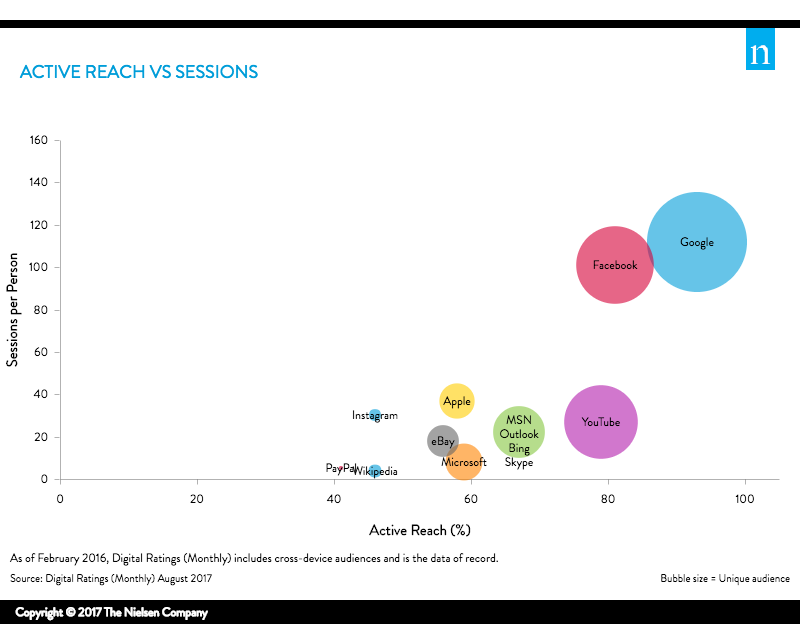
These sites create an appeal for the instantaneous access to information that is updated every minute, which hard to complete with. We can take note however on the design and simplicity of these sites and how they order their information. They are the masters in this field basing revenue on the level of engagement of their audience.
As educators using online resources also, we should have a duty of care to help students navigate the online world as they learn to interact, significantly with this internet giants. Being aware that when you click on various social media ads, fill in various profile stats, add “friends” who you don’t know, or sign in with a uniform Google or Facebook sign-in for other apps, can all chip away to your security while influencing the material that appears in your social media feeds. Facebook and Google use many complex algorithms to target what they would see as the most relevant material to the user based on all of the above, to keep you engaged and click on more links. This can cause a few problems like:
- Narrowing views, not seeing alternate views to your own as your feed or searches are so highly targeted, it doesn’t allow you to experience things outside of what you might normally think or consider.
- Privacy, ensure your settings are up-to-date so that no one outside of your approved list can view your activity. Having 1000+ friends might be seen as “cool” however you now have 1000 “friends” and their friends all seeing that your family is away on a month long trip to Italy i.e. no-one is at home to protect it. Even Kim Kardashian learnt this the hard way.
- What goes online stays online, even though you might delete it, it is still sitting on someone else’s server. A lesson for all young players on snapchat.
What can be done…of course the obvious education on cyber safety and adblocking, but even more important as a role as a teacher to promote constant critical thinking of our students. Promote wider research across various projects, have them collaborate with people in class they may not normally to gain wider views, promote creative problem solving.
O’Connor, Z. (2015). Colour, contrast and gestalt theories of perception: The impact in contemporary visual communications design. Colour Research and Application 40, 85–92.
McInerney, D. M., & McInerney, V. (2010). Educational psychology: Constructing learning (5th ed.). Frenchs Forest, NSW: Prentice Hall
 Next Post